
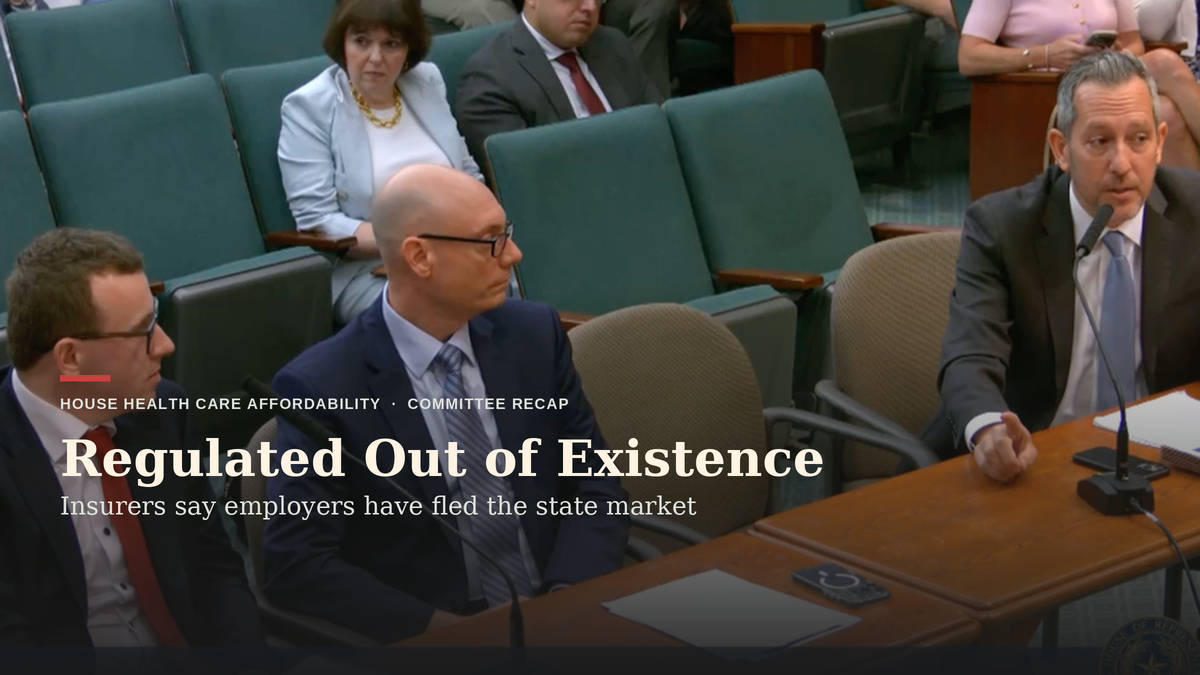
Texas health insurers told a House committee Sept. 1 that state regulations have contributed to employers moving away from the fully insured market.
“About 80% of that 15 million have gotten out of the state mandated, fully insured, regulated market,” said Blake Hudson, vice president of public affairs at the Texas Association of Health Plans, referring to the 15 million Texans with employer coverage. “The other 12 million have left it, and they’re fleeing it as fast as possible.”
Asked why plans cannot direct patients to lower-cost providers within that market, Hudson said, “You can’t do any of that. It’s just been regulated out of existence.”
The House Select Committee on Health Care Affordability spent about an hour and a half of its six-hour invited-testimony hearing discussing its second interim charge, flexibility in plan design. Members also discussed the committee’s fourth charge, price transparency. The committee took no votes during the interim hearing.
Hudson said Texas network-adequacy standards are “roughly double the size of what the federal ACA requirements are” and that insurers have had to seek waivers to comply.
“Not a single insurer can be compliant with the new law. They all had to get waivers,” he said.
According to Hudson, the state’s largest PPO “went from needing 2500 waivers statewide … to nearly 9000 waivers under the new rules.” He said benefit mandates account for “about a 19% difference in the cost of their monthly premiums” and that steering patients based on price is prohibited in the fully insured market but permitted in the self-funded market.
During a discussion about price differences for breast reconstruction procedures and a surgeon who had been unable to join a network for two years, Hudson told committee members they would have to determine how much flexibility insurers should have in controlling costs.
“Members, you kind of want to have it both ways here,” he said. “Like, do you want us to get tough on prices? Do you want us to move away from networks? We can do that. But you have to let us do it.”
Executives from two insurers also discussed alternatives to traditional provider networks.
Patrick Quigley, CEO of Sidecar Health, said his company’s plan pays a benchmark amount for medical services and allows members to share in savings when they choose providers charging less.
“Keep half the savings themselves. If they choose a provider that charges more, they pay the difference,” Quigley said.
He said emergency room admissions are 45% lower among the company’s members while primary care use is 11% higher.
“The reason we have regulations around network adequacy … is because networks by definition are inadequate,” Quigley said.
Fred Turner, CEO of Curative, said obtaining a license for his company’s plan took about 14 months and required a “$27 million commitment just to pass go.”
Turner said some hospitals owned by insurance companies “have refused to contract with us at even double the going market rate.” He also said Texas has “any willing provider laws” but no corresponding requirement for providers to accept payment from willing insurers.
“There is no equivalent for payers. There is no any willing payer,” Turner said.
Turner described a case in which he said a patient’s obstetric exam was cut short because of the payment card associated with her insurance plan.
Rep. Tom Oliverson, R-Cypress, said he would work with Turner on the issue.
“I want to commit to you publicly that I’m here to work with you,” Oliverson said. “I do think that the cash card should count towards fulfilling those requirements.”
Rep. Daniel Alders, R-Tyler, questioned whether provider networks are necessary.
“Was our networks really necessary? And it sounds like no, they’re not,” Alders said. “I’m not hearing any good argument for keeping them around.”
Alders also asked Turner whether the industry’s structure creates “a perverse incentive to crank up prices.”
“Yes, sir,” Turner replied.
Chair James B. Frank, R-Wichita Falls, questioned whether deductibles give patients enough incentive to compare prices.
“You could have a place that’s 40,000 and another that’s 20 for the exact same thing,” Frank said. “The deductible doesn’t get them, doesn’t encourage them to do anything else.”
Frank also said insurers “by and large, make more money when the spend is higher. It’s like the house in Vegas no matter what.”
Hudson said rules implementing shared-savings provisions from legislation passed last year have not been finalized by the Texas Department of Insurance.
Committee members also discussed enforcement of hospital price-transparency requirements.
Vivian Ho of Rice University’s Baker Institute told members that Senate Bill 1137, the state’s 2021 hospital price-transparency law, includes “significant fines” for violations but that she was unaware of hospitals being fined.
“As far as I can tell … no hospitals have been fined,” Ho said.
Ho said a sample of Houston hospitals showed listed prices for gallbladder surgery ranging from $3,774 at one hospital to $11,200 at another, with a third listing the procedure at $5,872.
Oliverson said the law has “extremely stiff penalties” but that noncompliance remains.
“I think it’s probably not being enforced,” he said. “I’m going to take that up with the agency.”
Rep. Shelley Luther, R-Tom Bean, earlier asked two physicians whether they post prices online. One responded, “I’m all for it,” before acknowledging that the practice did not post its prices online.
Luther said physicians “say we love transparency … but they’re not doing it.”
Oliverson also questioned the cost of accessing the state’s all-payer claims database, created by House Bill 2090.
“The cost to access the data is actually not nominal. It’s actually substantial,” Oliverson said. “If that data is not accessible to researchers, what are we even doing?”
Rep. Jay Dean, R-Longview, said lawmakers were examining the issue.
“We’re already looking into that now,” Dean said.
The Teacher Retirement System also presented information about its TRS-ActiveCare rewards program.
Chief Health Officer Megan Bludau said the program, which caps rewards at $600 per household, “has paid out $4 million in rewards. But that has saved the plan $17 million.”
Frank questioned why the state plan does not provide larger financial incentives for patients to select lower-cost facilities.
“If you’ll go here, you can pay $1,000. But we don’t do that,” Frank said. “I just don’t know why.”
Bludau said TRS hopes to expand facility tiering “even in the next plan year.”
The 90th Texas Legislature convenes in January 2027.
The bulk of the hearing — about four hours across the physician, hospital, drug-pricing and direct-contracting panels — went to the committee’s first charge on delivery and financing models, where Chair Frank called hospital cost shifting a “myth” and Mark Cuban offered Texas a free model PBM contract; that is the subject of the companion recap, “House Health Chair Calls Hospital Cost Shifting a ‘Myth’ as Hospitals Report $9 Billion in Unpaid Care.” On small-employer coverage, Hudson said the small-group market has fallen from about 1.3 million covered lives to roughly 600,000 and “only about 37% of small employers… offer coverage at all anymore.”
Fact box
- Issue
- Interim charge 2 — flexibility and innovation in plan design to improve affordability while maintaining access (approx. 1 hour 35 minutes, about 25 percent of the hearing; second-longest), with the charge 4 transparency thread (approx. 45 minutes)
- What happened
- TAHP said 80 percent of employer-covered Texans have left the state-regulated market and that no insurer can meet the state’s new network-adequacy law without waivers; Sidecar Health and Curative argued for no-network and cash-card models and Rep. Oliverson committed to count cash cards toward adequacy; Rep. Alders said he heard no argument for keeping networks; a Rice economist said no hospital has been fined under the 2021 price-transparency law and Oliverson said he will take enforcement up with TDI; TRS reported $17 million saved on $4 million in rewards; no vote (interim hearing)
- When
- Tuesday, Sept. 1, 2026, 9:00 AM CT · run time approx. 6:25:48, including a six-minute recess
- Where
- Room E2.016, Capitol Extension, Austin
- Chair
- Rep. James B. Frank, R–Wichita Falls (HD-69); Vice Chair Rep. Toni Rose, D–Dallas (HD-110)
- Key witnesses
- Blake Hudson (Texas Association of Health Plans); Patrick Quigley (Sidecar Health); Fred Turner (Curative); Vivian Ho (Baker Institute, Rice University); Megan Bludau (Teacher Retirement System of Texas); Charles Miller (Texas 2036)
- Archived video
- house.texas.gov video 22805