
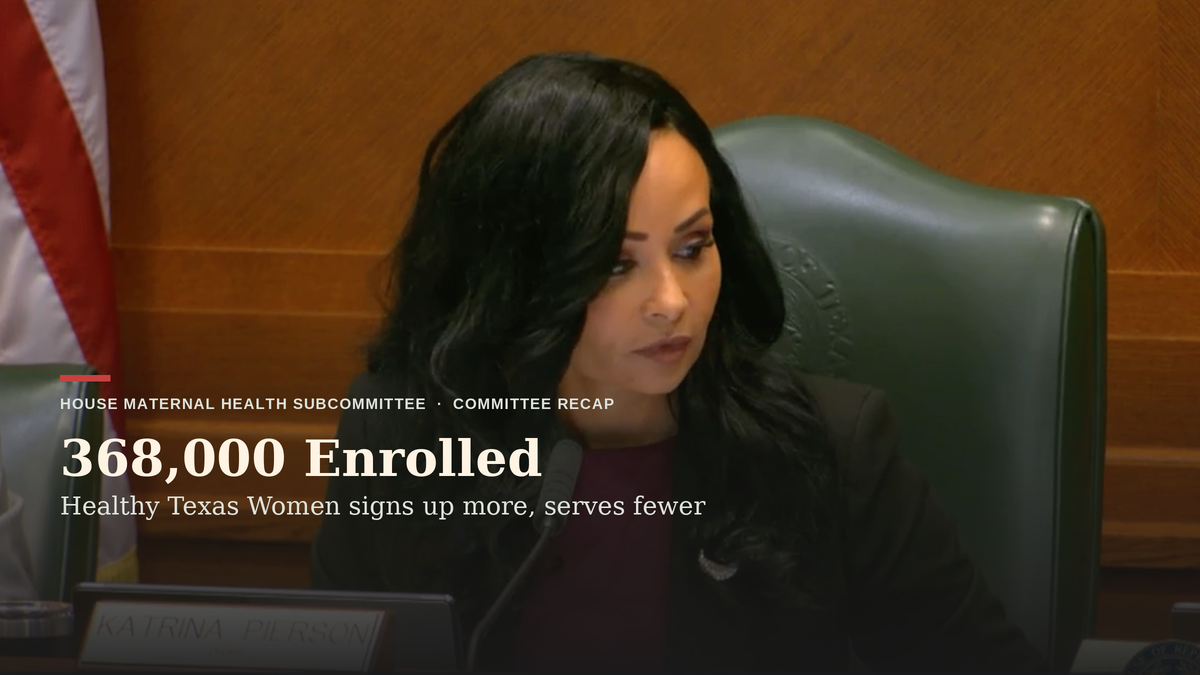
Texas has enrolled more than 368,000 women in its flagship no-cost women’s health program. Fewer of them are using it. That gap was the first thing Rep. Katrina Pierson, R–Rockwall, went after Sept. 15, when the new House Subcommittee on Maternal Health, Menopause and Access to Evidence-Based Medicine held its first hearing and spent two hours and 55 minutes — nearly 60 percent of its day — on whether Healthy Texas Women works.
“It looks like the healthy Texas women enrollment has increased, but the number of women being served or the services in themselves have declined,” Pierson said. “Is that accurate?”
Valerie Mays, deputy state Medicaid director at the Texas Health and Human Services Commission, conceded it. “It is accurate that a lower number of women are utilizing services than the total number of women enrolled in the Healthy Texas Women program,” she said. Asked what explains the widening gap, Mays offered the agency’s read: “Certainly, having access does not necessarily mean that someone is going in to receive services.”
Under the hearing notice, which limited testimony to invited witnesses, Mays laid out the program’s shape. Healthy Texas Women covered “more than 368,000 Texas women” as of November 2025, alongside just under 258,000 in Medicaid for Pregnant Women. It runs on a federal Section 1115 demonstration waiver renewed through June 30, 2030, at a 90-cent federal match, and had 2,696 active providers in fiscal 2025.
Then Mays disclosed the gap that will follow the subcommittee into its second charge. “I do want to note that the Healthy Texas Women program does not cover iron supplements or prenatal vitamins at this time,” she said — even though full Medicaid covers both with a prescription for pregnant women.
Budget pressure arrived next. Every state agency was directed by the Legislative Budget Board to cut its appropriations request by 3 percent, Mays said, “and for HHS, that means meeting a target of about $331 million.” One of the items on the chopping block reaches directly into this program: “there are currently 32 providers out of 3500 [Healthy Texas Women] providers that receive the cost reimbursement funding,” she said, and “this is a proposed program for elimination in the 3% reduction.”
Rep. Liz Campos, D–San Antonio, pushed on whether the provider network can absorb anything. “There’s a shortage of staffing throughout the health care industry,” she said. “How many providers are accepting applications at this time?” Crystal Stucky, the agency’s deputy executive commissioner for family health services, said there is “not necessarily a wait for services” but that “we have heard from providers that there are staffing challenges.”
Rep. Joanne W. Shofner, R–Nacogdoches, kept the focus rural. Noting that many program sites cluster in urban counties, she asked what House Bill 1575 actually bought. Mays clarified the limit: “Doulas have been added to provide case management services. And so they are not providing traditional [doula] services today.”
The distance problem got its sharpest illustration from Kristen Llano of the Texas Women’s Healthcare Coalition, a group of more than 75 health care, faith and community organizations. She described a teenager in East Texas who went into preterm labor: “The family lived in Jasper, but the closest hospital to them was in Lufkin. They were driving through the National Forest when their car broke down… And the infant did not make it.”
Dr. Sally Peralez, chief clinical officer at South Texas Family Planning and Health Corporation, put a number on why rural providers are scarce. Comparing Medicaid rates to private practice, she said, “when you’re comparing with private practice that can get funded about $300 versus the $27, it’s really a mission of, of love and hope out there.”
Dr. Deborah Fuller, a Dallas obstetrician-gynecologist testifying for the Texas Medical Association, brought the fix most likely to become a bill. Women who age out of pregnancy Medicaid must apply again to reach the postpartum package, and many do not. She asked the Legislature to “streamline the Medicaid for pregnant women to H.W. plus transition into a single continuous enrollment event rather than two separate applications. Since attrition at that point undermines the postpartum morbidity goals.” She also previewed the subcommittee’s menopause charge, urging that hormone replacement therapy be added as a covered service for women 45 to 64.
Craig Smith, president and CEO of Driscoll Health Plan, offered the day’s most concrete return on investment — and its most candid caveat. His plan covers 183,000 lives across 24 South Texas counties, and its outreach program cut the regional preterm birth rate from above 15 percent to 10 percent. “We believe we saved over $1 billion over a ten year period,” he said, “of mostly NICU avoidance.” Asked by Pierson whether other managed care organizations could copy it, Smith answered, “Well, it’s expensive, so yes.” Then he volunteered what the slides do not show: “we also see that success decline, just to be very transparent about it over time. The diabetes, all of the related chronic conditions keep getting worse.”
Brooke Garner of the Texas Public Policy Foundation argued coverage is not the same as care, citing 2024 data in which “approximately 1 in 9 Texas women, Texas mothers, began prenatal care in the third trimester or received no prenatal care at all.” Her framing: “can a woman who is in a health care program actually receive care before that condition worsens or before it becomes more costly? The answer right now is really no.” She asked the Legislature to shift the burden of proof in prior authorization onto insurers. Pierson tested the limit: “how would that exception work without allowing every physician to bypass prior authorization simply by declaring exception?”
This is an interim hearing and no votes were taken. Pierson opened by naming all six of the panel’s charges and setting the frame she intends to carry into the 90th Legislature: “Prevention is not only sound health policy, it is sound fiscal policy.”
The subcommittee spent its remaining two hours on iron and prenatal nutrition, where a North Texas coalition reported cutting a regional blood transfusion rate by distributing iron directly to pregnant women and said it is drafting a statewide standing delegated order to make iron a Medicaid benefit — the subject of the companion recap, “Texas Weighs Making Iron a Medicaid Benefit After a North Texas Program Cut Transfusions.” Rachel Bowden of the Texas Department of Insurance also briefed members on the roughly 22 percent of Texans in fully insured commercial plans the agency regulates, telling them the department’s triennial examinations check “were the process requirements followed appropriately” and that examiners are “not getting into the clinical judgment.”
Fact box
- Issue
- Interim charge — effectiveness of Healthy Texas Women and related women’s health programs (approx. 2 hours 55 minutes, about 59 percent of the hearing; longest block)
- What happened
- HHSC confirmed that enrollment in Healthy Texas Women exceeds use of its services, that the program covers more than 368,000 women, and that it does not cover iron supplements or prenatal vitamins; the agency faces a $331 million reduction target under a 3 percent Legislative Budget Board directive, with cost-reimbursement funding for 32 providers proposed for elimination; the Texas Medical Association asked for a single continuous enrollment event into the postpartum package; Driscoll Health Plan reported cutting its regional preterm birth rate to 10 percent; no vote (interim hearing)
- When
- Tuesday, Sept. 15, 2026, 10:00 AM CT · run time 4:58:16
- Where
- Room E2.030, Capitol Extension, Austin
- Chair
- Rep. Katrina Pierson, R–Rockwall (HD-33); no vice chair designated
- Key witnesses
- Valerie Mays and Crystal Stucky, Texas Health and Human Services Commission; Dr. Deborah Fuller, Texas Medical Association; Kristen Llano, Texas Women’s Healthcare Coalition; Dr. Sally Peralez, South Texas Family Planning and Health Corporation; Rachel Bowden, Texas Department of Insurance; Craig Smith, Driscoll Health Plan; Brooke Garner, Texas Public Policy Foundation
- Archived video
- house.texas.gov video 22862