
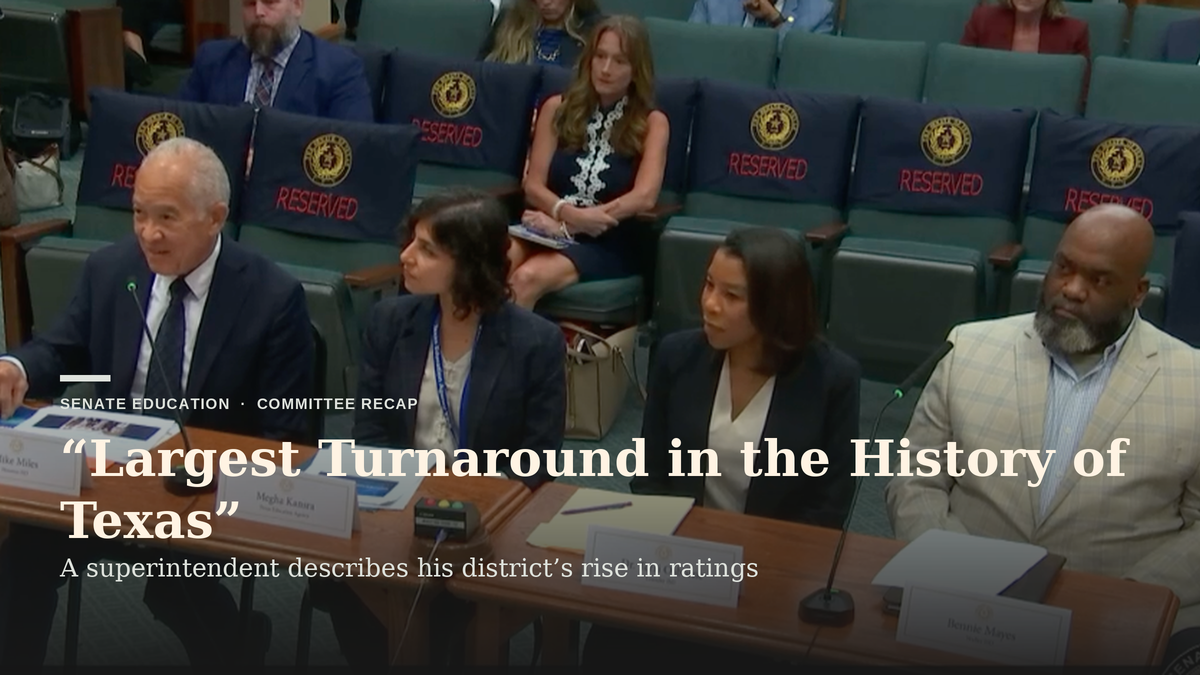
Houston Independent School District Superintendent Mike Miles told the Senate Education Committee on Oct. 6 that his three years running the state’s largest district amount to “certainly largest turnaround in the history of Texas.” Sen. José Menendez, D-San Antonio, pressed him on special education compliance and on the roughly 21,000 students who have left the district.
Miles was appointed as the superintendent of Houston ISD in mid-2023 after the Texas Education Agency initiated a formal takeover of the district due to low academic performance ratings at some district schools.
He opened by calling himself “the controversial superintendent of HISD.” He told the Senate Education Committee, hearing its interim charge on school-turnaround leadership, that his district went from 93 A- and B-rated campuses to 205, a count the district’s website also lists. On teacher turnover, he said 87 percent of teachers working in May returned in August. The first year was harsher: about 30 percent turnover, he said, after the district cut 800 teaching positions and “we removed 1,400 teachers ourselves.”
Miles framed the leadership problem he inherited in blunt terms. His slides listed no common focus on instruction, a low-performance culture, low expectations, no accountability and no experience with wholesale reform, across 274 autonomous schools. “If you’re trying to do whole scale systemic reform, that’s another level of leadership altogether,” he said. The fix, as he described it, includes a weekly routine: principals and assistant principals each conduct six spot observations of teachers a week and coach on the job daily.
He said accountability applies to everyone. “If you don’t make that bar over time, with support, with training, then you are removed from the organization,” Miles said. “And that goes for teacher, principal, executive director and, and the superintendent. If I don’t get the outcomes we need, then I should be gone.” He pointed to narrowing achievement gaps. Black middle schoolers in math, he said, were 38 percentage points behind white peers three years ago and are 22 behind now. Hispanic students moved from 30 points behind to 15. “Give us a couple more years and that gap will be in the single digits,” he said. Waller ISD Superintendent Bennie Mayes and a TEA deputy commissioner also testified on the panel.
Sen. Paul Bettencourt, R-Houston, the vice chair, questioned Miles on durability. He said enrollment keeps declining, then asked whether the model survives it. “Once you get a transformational organization started, it could last decades,” Bettencourt said, and Miles agreed. Bettencourt called the district’s industry-certification and college-credit growth “astonishing numbers” and said enrollment faces “some macro forces here at work” that no single district controls.
Menendez changed the tone. “I just want to dig in a little deeper because, I think the most important thing that we can do is just, measure apples to apples,” he said. He asked about Texas Education Agency findings on special education. “My understanding is that there were violations of the SPED requirements that resulted in a new correction plan,” Menendez said.
Miles did not dispute it. “We are under intervention partly because of compliance with IEPs and ARDs,” he said. The district has improved, he said, “but it’s not 100% yet.”
Menendez then raised enrollment. “There has been a concern that since your administration have come in that there are about 21,000 students have left the district,” he said. He asked where they went and whether the gains reflect “an emphasis on only helping rise those students who could perform the best.” Miles answered with campus ratings and gap data rather than a count of departed students. “We went from 93 A and B rated campuses to 205,” he said.
Menendez also asked whether Houston’s approach could be copied. He noted the district pays teachers more than the average district and spends somewhat more than the state. “Is this something we could replicate if possible, if, is it feasible financially?” he asked. “Yes, sir, it’s feasible,” Miles said. He said the district balanced its budget last year and expects to do so for 2026-27.
No vote was taken. The committee’s charge asks for suggestions to strengthen the leadership pipeline, and members did not say which Houston practices they would turn into law. Special education compliance and where the district’s students went are likely to follow the discussion into the 90th Legislature, which convenes in January 2027. The Texas Dispatch previewed this hearing.
The committee’s longest charge, about 169 minutes, covered four-day school weeks; see the companion recap, “Four-Day School Weeks Cost Students Learning, Education Commissioner Tells Senate Panel.” It also heard about 46 minutes on shrinking enrollment, 45 minutes on teacher pay under House Bill 2, and 46 minutes from TEA’s inspector general on Senate Bill 571, where complaint reports rose from 5,707 to 19,766. Public testimony followed.
Fact box
- Issue
- Interim charge on improving school transformation talent and the leadership pipeline (approx. 83 minutes, about 17 percent of the hearing)
- What happened
- Houston ISD Superintendent Mike Miles described the district’s turnaround; Sen. Menendez pressed on special education compliance, departed students and replicability. No vote — interim hearing.
- When
- Tuesday, Oct. 6, 2026 · run time about 7:58 (4,783 caption segments)
- Where
- Room E1.028, Capitol Extension, Austin
- Chair
- Sen. Donna Campbell, R–New Braunfels (SD-25); Vice Chair Sen. Paul Bettencourt, R–Houston (SD-7)
- Key witnesses
- Mike Miles, superintendent, Houston ISD; Bennie Mayes, superintendent, Waller ISD; a TEA deputy commissioner
- Archived video
- senate.texas.gov video 22858