
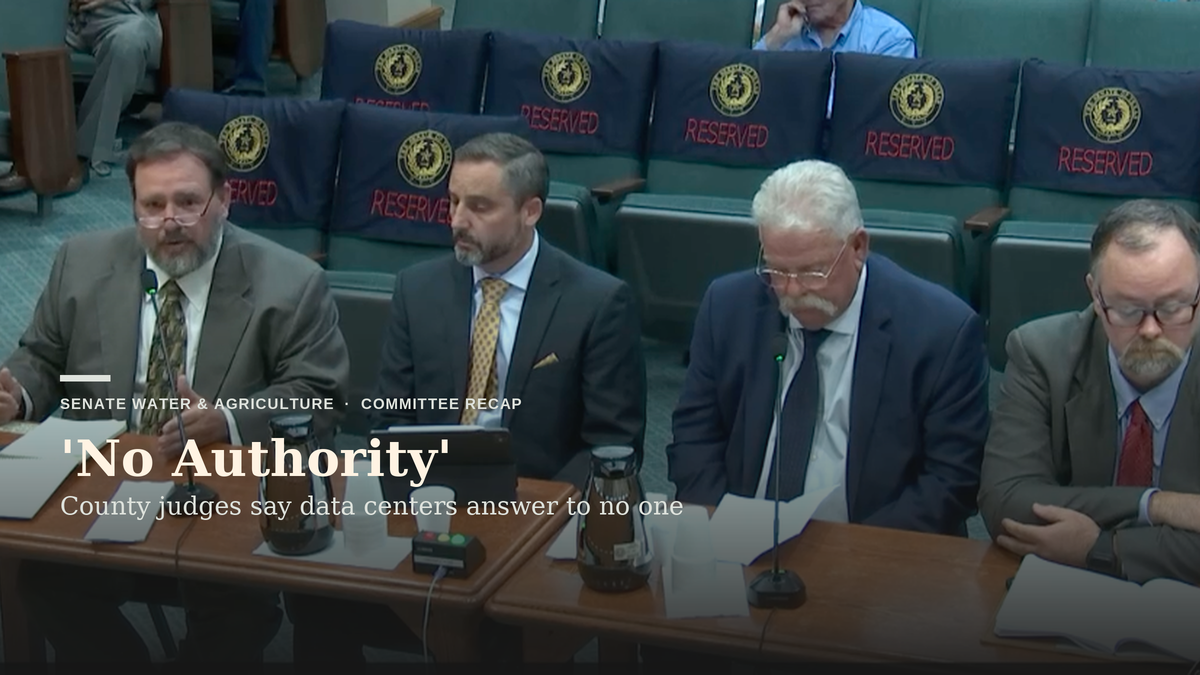
Three data center companies told a Senate committee Sept. 1 that they cool without fresh water and will pay for rural pipelines. The county officials who followed them said the problem is not the companies at the witness table. It is the ones that never call back.
“The number one issue that I hear from our folks is we don’t have the authority to do anything,” said Rick Thompson, program director of the County Judges and Commissioners Association of Texas. “We cannot compel the… tire kickers or any of the other folks to come along and be open and honest about what their plans are. We find out after the fact.”
The Senate Committee on Water, Agriculture and Rural Affairs gave roughly four hours of a nearly seven-hour hearing to the transparency and affordability half of its interim charge on data center water use. Because this was an interim hearing, the panel took no votes. Chairman Charles Perry, R–Lubbock, set the tone before the first witness, naming a company he said “choose[s] not to answer their phones… They choose to operate in secrecy… I don’t believe they’re actually a data center. I think they’re more of a power generation station.”
The industry panel arrived with commitments. Ben Townsend, Google’s global head of infrastructure strategy and sustainability, said all of the company’s planned Texas sites “are designed with advanced closed loop air cooling systems that will help us eliminate freshwater consumption for cooling,” and that Google has “committed more than $500 million in public water and wastewater infrastructure upgrades,” including “a $4.5 million contribution to replace an aging water pipeline” in Vernon.
Michael McNamara, CEO of Lancium, developer of the Stargate campus in Abilene, said city officials there budgeted “500 gallons per minute” for the site. “In the last trailing 12 months, that campus has consumed 20 gallons a minute, so 95% less than the local municipal municipality had decided was adequate.” In Childress, where The Texas Dispatch reported the company’s offer of a temporary water supply in August, he said Lancium “will build a 16 mile pipeline, a reverse osmosis system, and we will drop a million gallons a day of totally fresh water into the Greenbelt Water Authority,” at “at least $20 million.” Ryan Keith of QTS said every facility the company has built since 2019 “consumes essentially zero water for cooling” and announced “a $250 million pledge to Texas water infrastructure over the next decade.”
Members were not fully sold. Sen. Lois Kolkhorst, R–Brenham, said she had turned to a colleague: “I mean, Democrat, Republican, I go, how much money are they making? If they can just give 250 million out to the communities?” She asked what the facilities are for — “Is it autonomous weapons?… or is it government surveillance?” Vice Chair Kevin Sparks, R–Midland, said the committee’s job “is to make sure that we don’t look up a few years from now and realize that the burden of what you guys have put in has been socialized through transmission or any other way.”
Under questioning from Sen. Adam Hinojosa, R–Corpus Christi, the closed-loop story developed exceptions. Keith said QTS owns two purchased facilities that “do consume water with open loop evaporative systems.” Townsend said Google’s Midlothian and Red Oak campuses use evaporative cooling in part, defended it as more energy-efficient — “That is a fundamental law of physics” — and said the benefit “can be unlocked with brackish water or treated produced water.” Keith said he “would not force just closed loop.” Sen. Roland Gutierrez, D–San Antonio, called for “a tax structure that’s going to compensate for the water use.”
Perry drew a line on cost. “We’re not going to allow you to charge the consumer for any infrastructure on water and power,” he said.
The county panel described a different industry. Thompson said his board wants three things: buffer zones — he described “a data center right next to a jail, which is right next to a hospital, which is right next to a nursing home… If that thing catches on fire, who do you evacuate first?” — mandatory community hearings, and water availability studies, because “there’s almost 100 counties that don’t have” a groundwater district and “these guys aren’t hydrologists.”
Kevin Hodges, city manager of Childress, said, “Every one of us are in stage four of our drought contingency plan. There is no stage five.” Caldwell County Judge Hoppy Haden said his county wrote closed-loop cooling and a “200 gallons per megawatt per month limit” into its tax agreements, then described the offers landing on ranchers. “I’m a rancher, I’m 63… somebody floating an offer for $95,000 an acre for my biggest asset, what am I to do?” he said. “For every one of those projects, there’s a hundred out there… they’re going to be gone like smoke.”
Thompson said a Panhandle judge who told voters that tax agreements were his only leverage “lost his election overwhelmingly because he told them the truth.” Perry answered: “Give me the list.” He later asked, “Can we statutory require that they communicate with you guys?” Kolkhorst went further: “I think, all 254 counties in the state of Texas need to be under water district.”
Public witnesses had two minutes each and used them on the pledges. Amanda Alderete of Texans Against Data Centers United told the industry, “Thank you for the 250 million or whatever. It’s chump change, sir.” Rita Beving of Public Citizen said the survey penalty “is at $500. If it was enforced.” Usman Mahmood of Bayou City Waterkeeper urged senators “to extend the SB six model to water in 2027,” a reference to Senate Bill 6, the 2025 large-load law.
Perry told the county officials that developers unwilling to engage communities “are not people that should be awarded, I think, state permitting.” He said a bill is nearly drafted. The 90th Legislature convenes in January 2027.
The committee’s first two and a half hours went to the question of how much water data centers actually use, where the Texas Water Development Board reported a 30 percent response to its mandatory survey, the PUC reported 1.3 billion gallons used by 81 operating facilities in 2025 and Chair Perry promised evaporative cooling “won’t be allowed coming out of next session”; that is the subject of the companion recap, “Perry Vows to Ban Evaporative Cooling After 70 Percent of Data Centers Ignore State Water Survey.” UT researchers projected data centers could grow from 0.5 percent to more than 5 percent of state water use.
Fact box
- Issue
- Interim charge — assessing the water demands of energy-intensive technologies: transparency for local water providers, county and groundwater-district authority, and affordability for residents and agricultural producers (approx. 4 hours 3 minutes, about 58 percent of the hearing; longest block, ranked second on news judgment)
- What happened
- Google, Lancium and QTS described closed-loop cooling and pledged $500 million, at least $20 million and $250 million respectively for water infrastructure, then acknowledged evaporative cooling at existing sites; county judges said they cannot compel developers to disclose plans and asked for buffer zones, mandatory hearings and water availability studies; Chair Perry said developers who will not engage communities should not get state permits and asked whether communication can be required by statute; public witnesses called the pledges “chump change”; no vote (interim hearing)
- When
- Tuesday, Sept. 1, 2026, 9:00 AM CT · run time approx. 6:56:31, no formal recess
- Where
- Room E1.012 (Hearing Room), Capitol Extension, Austin
- Chair
- Sen. Charles Perry, R–Lubbock (SD-28); Vice Chair Sen. Kevin Sparks, R–Midland (SD-31)
- Key witnesses
- Ben Townsend (Google); Michael McNamara (Lancium); Ryan Keith (QTS); Rick Thompson (County Judges and Commissioners Association of Texas); Kevin Hodges (City of Childress); Hoppy Haden (Caldwell County judge); Amanda Alderete (Texans Against Data Centers United); Rita Beving (Public Citizen); Usman Mahmood (Bayou City Waterkeeper)
- Archived video
- senate.texas.gov video 22662